Featured

CFSA’s Guide to the 2023 Connecticut Legislative Session

Happy New Year! The Connecticut General Assembly opened for the “long session” on January 4. In a long session, legislators negotiate the budget and do not limit what types of bills can be introduced (compared to the short session, which is typically limited to budgetary and financial issues). This year’s session ends June 7.

As in past years, CFSA will be tracking bills that have a potential impact on the food system. Every week, we’ll post updates on those bills as they move through the legislature. The list will be updated here and weekly via our listserv. We hope this information makes it easier for you to advocate for a sustainable, equitable food system! If you find this useful, please this page with colleagues and friends to grow our alliance.

The Capitol and Legislative Office Building are open to the public this year, and we have the option to testify in person or virtually! CT Mirror has more information on this year’s session.

Tracked Bills (table)

Tracked Bills (text)

Follow the links below for more info about the legislative session:

Disclaimer about bills tracked by the CFSA:

The Connecticut Food System Alliance uses systems thinking in our work, as well as a racial and social justice lens. We take a broad approach to tracking bills that have an impact on the food system: issues of public health, labor rights and minimum wage, and land use often end up on our tracked bill list. Tracking a bill does not mean the CFSA supports or opposes the bill โ€“ only that it would have an impact on the food system. If you think any bill is missing from our tracking, let us know!

Aligned policy platforms:

Below are links to partner and sibling organizationsโ€™ state legislative priorities (let us know if there are additional platforms/agendas we should know about! This list will be updated).

New Local Food Spending Report Highlights Growth Potential

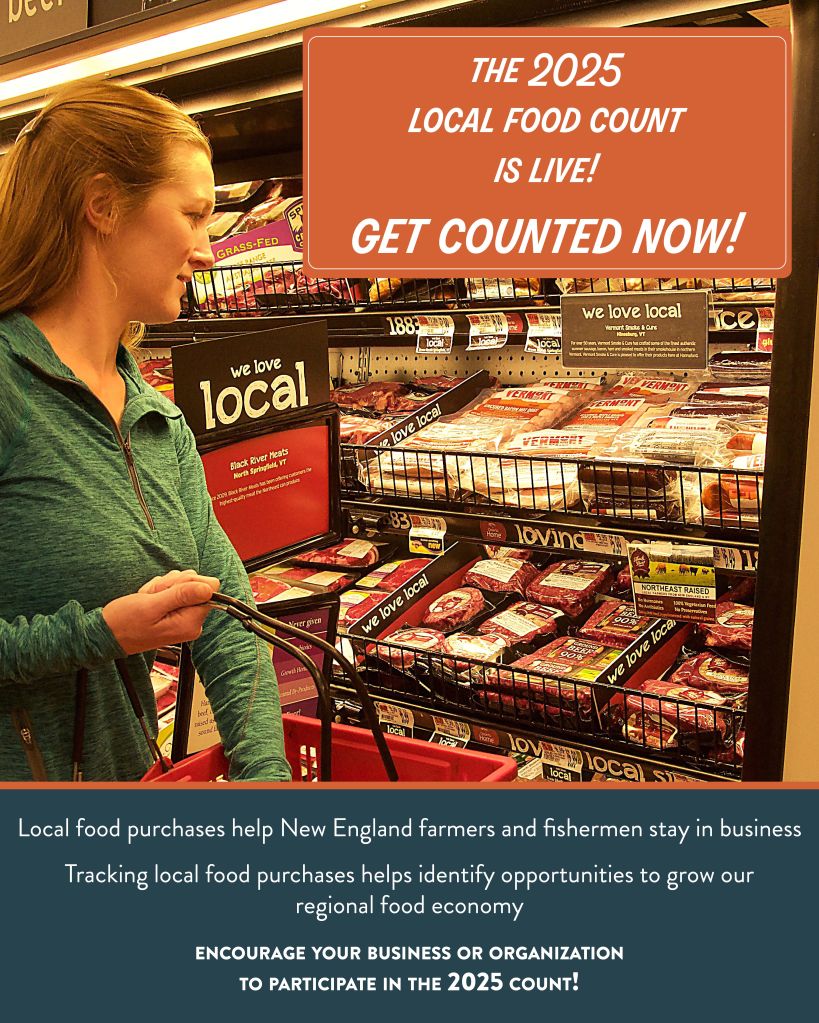
The New England Food System Planners Partnership has just released Connecticutโ€™s Local Food Count 2022 and a New England-wide Regional Food Count 2022, shedding light on local food spending across New England. The Local Food Count 2022 reveals that $709 million or 2.7% of the state’s total $26.3 billion in food, beverage and alcohol expenditures were spent on local and regional products. This report is crucial in the journey towards a more resilient and self-sufficient food system.

Want to know more? Click here to dive into the details and see how you can support the goal of 30% local food consumption by 2030.

In this report, โ€˜localโ€™ is defined as food grown or produced in Connecticut and ‘regional’ is defined as food grown or produced in New England. The report estimates spending on local products at grocery stores at $239 million (4.2% of total grocery store spending), spending via direct sales channelsโ€”farmers markets, CSAs, farm standsโ€”was considered 100% local, as were home production (e.g., gardens) and donations. Spending on local products at full-service restaurants was estimated at $120 million (3.0% of total full-service restaurant spending), while schools and colleges accounted for $51 million (6.9%). โ€œFood furnished and donated,โ€ which includes food served at hospitals, prisons, and assisted living facilities, accounted for $30 million (3.9%). Accompanying the local food count is an interactive data dashboard, enabling a look at the Regional and State level results.undefined

“Most of us get most of our food from the grocery store, so grocery retailers are key players in reaching the 30% goal. New England farmers and fishermen need more access to the market channels that are part of our daily lives,” said Meg Hourigan, Coordinator of the Connecticut Food System Alliance, member of the New England Food System Planners Partnership.

Residents and Business Owners Encouraged to Choose Local Food!

For New England grocery stores, restaurant owners and chefs, sourcing local and regional food can be an economic boost for businesses in the region. By including better signage and labeling on shelves or featuring menu items that promote local farms, seafood, and other seafood producers, this commitment from New Englanders to New Englanders drives sales, keeps dollars close at home and supports jobs for the community.

Institutions such as colleges, hospitals, and schools, have already implemented strategies to expand local and regional food offerings; more can be done through state policy and funding commitments. 

โ€œIn New England, we have incredible farmers, fishers and producers as well as food businesses, restaurants and institutions that care about growing, sourcing and providing local and regional food to our communities,โ€ said Leah Rovner, Director of the New England Food System Planners Partnership. โ€œNew Englanders and visitors alike want to support these businesses and need to be given increasingly more opportunities to do so.โ€ 

Residents and business owners can help strengthen our regional food economy by choosing local and regional food when making purchases, keeping our dollars closer to home.

โ€œThe single best way we can make a difference now is to choose local and regional food items over those from far away. By shifting even just $10 per week from your existing current food purchases to local or regional food items goes a long way toward supporting our regional food economy,” said Rovner.

The Need to Capture Future Local Food Counts

This data serves as a baseline for future assessments, with subsequent counts planned for 2025 and 2030. The report also identifies gaps in current data, such as specific product details, and suggests areas for improvement in both data collection and local food system support. 

Goal: 30% Consumption of Regional Food Products by 2030

The local food count data collection is part of a greater effort to reach a regional goal of producing and consuming 30% of New Englandโ€™s food needs in the region by 2030. In 2023, the New England Food System Planners Partnership, a collaboration between seven state-level organizations, six-state agricultural, economic and environmental department representatives and Food Solutions New England (FSNE), released A Regional Approach to Food System Resilience. The research explores the opportunities and needs along the food supply chain in New England, and highlights the land, sea, and labor needs of the region, consumer purchase metrics, distribution trends, and population projections that will impact the regionโ€™s ability to feed itself in the coming years. 

The 2022 local food counts project was funded in part by the Connecticut Department of Agriculture through the Community Investment Act (C.G.S. Sec. 22-26j) and managed by the Connecticut Food System Alliance with research provided through the University of Connecticutโ€™s Zwick Center for Food and Resource Policy.

About the New England Food System Planners Partnership

The New England Food System Planners Partnership (NEFSPP) is a collaboration among seven state-level food system organizations, six-state agricultural, economic and environmental department representatives and Food Solutions New England (FSNE), a regional network that unites the food system community. Together, they are mobilizing regional networks to impact local and regional food supply chains and strengthen and grow the New England regional food system. The Partnership disseminates information on trends, challenges and opportunities to hundreds of groups across the region that connect with our individual state initiatives. The Partnership is fiscally sponsored by the Vermont Sustainable Jobs Fund. 

About Connecticut Department of Agriculture

The mission of the Connecticut Department of Agriculture is to foster a healthy economic, environmental and social climate for agriculture by developing, promoting, and regulating agricultural businesses; protecting agricultural and aquacultural resources; enforcing laws pertaining to domestic animals; and promoting an understanding among the stateโ€™s citizens of the diversity of Connecticut agriculture, its cultural heritage and its contribution to the stateโ€™s economy.

About University of Connecticutโ€™s Zwick Center for Food and Resource Policy

The Zwick Center for Food and Resource Policy located at the University of Connecticut (UConn) provides economic analysis for problems related to food, the environment, energy, and sustainable economic development.

The Center was named through a gift from alumnus Charles J. Zwick to UConnโ€™s Department of Agricultural and Resource Economics and has since expanded its mission and services. Zwick Center studies seek to provide practical, impartial analysis that supports the functioning of markets and informs decision-makers in the public and private sector. Learn more are.uconn.edu/zwick-center/

About the Connecticut Food System Alliance (CFSA)

Connecticut Food System Alliance (CFSA) is a state-wide network of dedicated stakeholders committed to creating broad systems change and advancing a sustainable and just food system in Connecticut. CFSA builds connections between groups and people committed to our shared goals of food security, food justice, and climate resilience. CFSA is working with partners to develop a state food action plan for achieving these goals. Formed in 2012, CFSA has been fiscally sponsored by Hartford Food System since 2014.

Pay-What-You-Can Food Retail Virtual Discussions (Fall 2023)

Windham Food Network and CT Food System Alliance, as part of the Eastern CT Regional Food System Partnership, in collaboration with The Foodshed Network, are convening two virtual discussions exploring pay-what-you-can food retail models. Please join us and helpโ€ฏspread the word!

The Eastern Connecticut Rooting Deep, Scaling Up project is exploring alternative food retail and distribution models that strengthen the local economy, support local farmers, and improve community food access. One of the priorities identified by the partnership is to explore and develop alternative models for food retail that improve market access for local farmers and healthy food access for consumers.

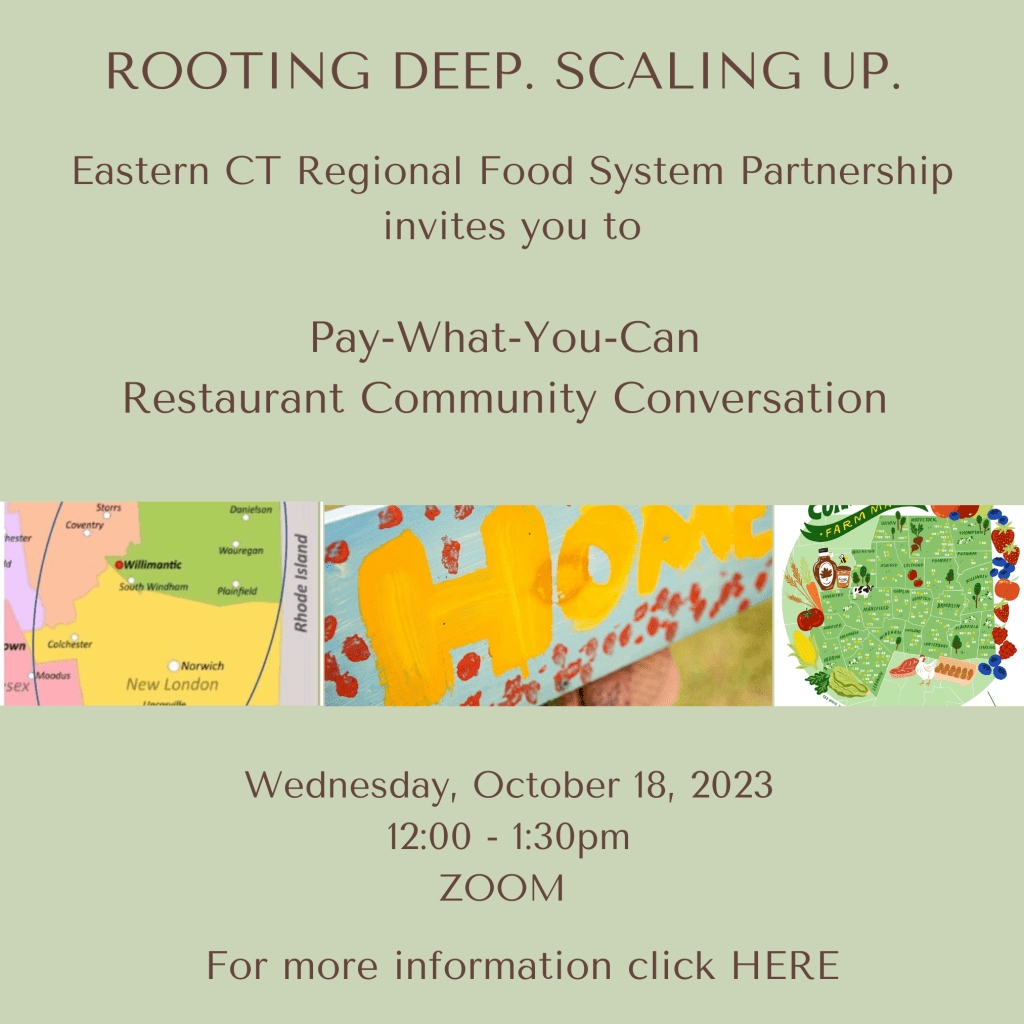
The first webinar will explore pay-what-you-can/sliding scaleโ€ฏrestaurant models, on October 18th at noon, via Zoom. The speakers include Mark Bittman, who is launching the Community Kitchen, and Molly Reynolds of the Hands on Hartford Gather55 restaurant. For more information and to register, clickโ€ฏhere.

Graphic with a light green background. The text reads:
"ROOTING DEEP. SCALING UP.
Eastern CT Regional Food System Partnership invites you to Pay-What-You-Can Restaurant Community Conversation - Wednesday, October 18, 2023 - 12:00 - 1:30pm ZOOM. For more information click HERE"
The center of the graphic has three images:
A map of Eastern Connecticut, showing parts of New London, Tolland, and Windham Counties; a photo of a hand-painted baby blue sign that reads HOME in yellow letters; and a stylized map of Eastern Connecticut towns bordered by strawberries, blueberries, meat, poultry, eggs, lettuce, corn, tomatoes, and maple syrup.

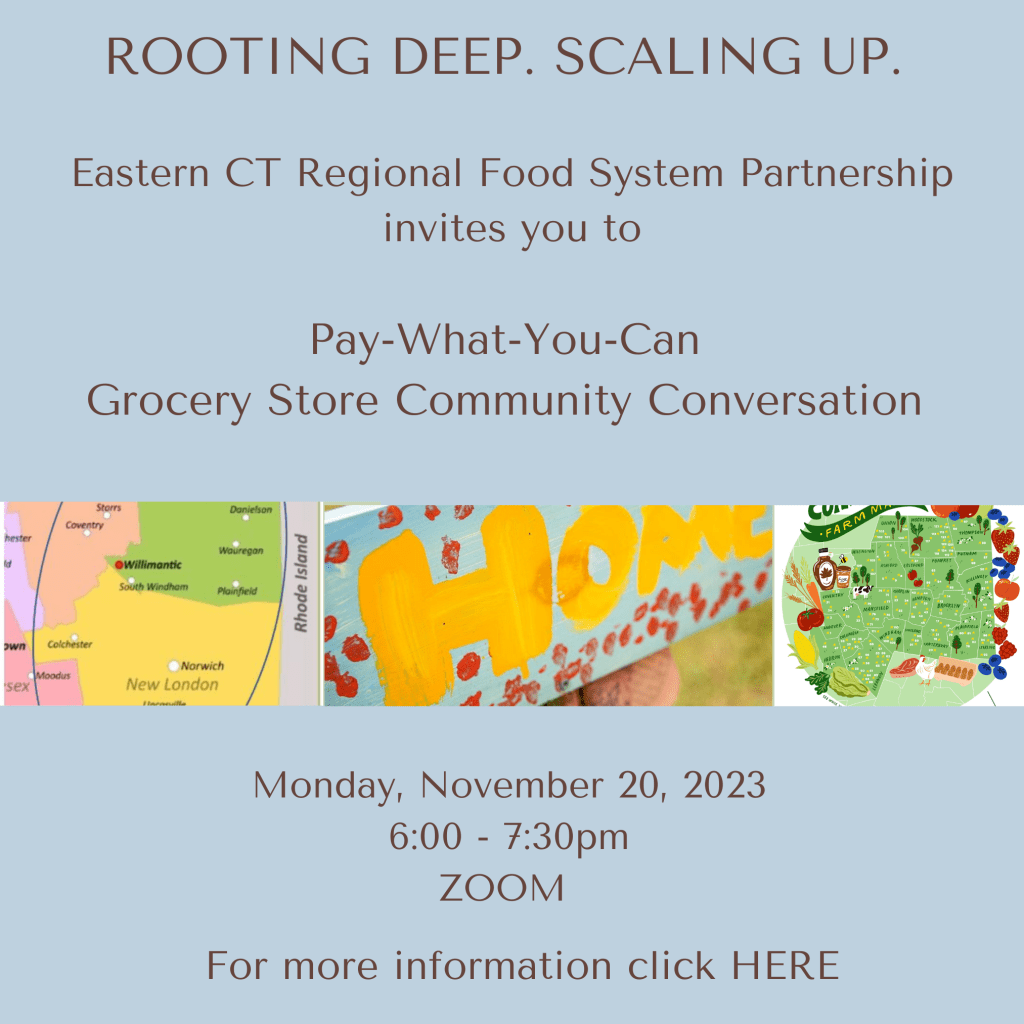
The second will explore pay-what-you-can/sliding scale grocery store models, on November 20th at 6:00pm, via Zoom. Speakers include Ben Dubow of Forge City Works (opening the Grocery on Broad next year) and Devyn Messinger, The Wild Ramp (West Virginia). Please save the date, the invitation to follow soon.

Graphic with a light blue background. The text reads:
"ROOTING DEEP. SCALING UP.
Eastern CT Regional Food System Partnership invites you to Pay-What-You-Can Grocery Store Community Conversation - Monday, November 20, 2023 - 6:00 - 7:30 PM ZOOM. For more information click HERE"
The center of the graphic has three images:
A map of Eastern Connecticut, showing parts of New London, Tolland, and Windham Counties; a photo of a hand-painted baby blue sign that reads HOME in yellow letters; and a stylized map of Eastern Connecticut towns bordered by strawberries, blueberries, meat, poultry, eggs, lettuce, corn, tomatoes, and maple syrup.

New research available โ€“ Can New England Feed Itself in the Years to Come?

JUNE 5, 2023

New England food advocates release new research on the state of the region’s food system

Report shows Connecticut consumer dollars are critical to making New England’s food system stronger, more self-reliant


A new report puts forth a regional goal of producing and consuming 30% of New Englandโ€™s food needs in the region by 2030. Commissioned by the New England State Food System Planners Partnership, a collaboration between Connecticut Food System Alliance, five other state-level organizations and Food Solutions New England, it outlines the role New Englanders can play in making the regionโ€™s food system stronger and more self-reliant. The report โ€“ A Regional Approach to Food System Resilience โ€“ is a product of 16 researchers exploring the opportunities and needs along the food supply chain in New England, and highlights the land, sea, and labor needs of the region, consumer purchase metrics, distribution trends, and population projections that will impact the regionโ€™s ability to feed itself in the coming years. 

โ€œWe all experienced the limitations and shortcomings of a global food supply chain during the pandemic โ€“ developing the regional food system is a strategy for strengthening the local economy while reducing dependence on the dominant food system,โ€ said Meg Hourigan, Coordinator of the Connecticut Food System Alliance. โ€œBecoming more self-reliant requires expanding our food supply chains, building up infrastructure such as food processing and distribution, and retaining and diversifying stewardship of our land and sea resources. In return, it can mean more local jobs, more local food, a competitive business environment, and a more reliable food system that is less susceptible to interruptions caused by natural disasters or public health emergencies.โ€

The report, released publicly today, illustrates Connecticutโ€™s purchasing power in the effort to strengthen the local food system for itself and its New England neighbors. Connecticut is home to 24% of the regionโ€™s population and accounts for 22% of retail food sales, or $19 billion, according to the report. It is also home to 21% of food sector employment in the region. But Connecticut holds only 10% of agricultural land, meaning our local food supply chain is highly reliant on producers from outside its borders.

New England states had a total food expenditure of over $87.1 billion in 2019, or about $5,868 per person in the region. In order to ensure that 30% of New Englandโ€™s food needs are met with New England products, the average New Englander would have to spend about $1,760 of that total food expenditure on regionally-produced food. By 2030, total food expenditures are projected to reach $98.4 billion, or about $1,890 per person to reach the 30% goal.

โ€œThe gap between what Connecticut consumes and what it produces can come from across the country or even the world, or it can come from right next door at a farm, in a greenhouse, or from a fishery right here in New England,โ€ said Martha Page, Consultant and Connecticut Food System Alliance Steering Committee member. โ€œTogether, we can build a comprehensive food system development plan here in Connecticut in order to strengthen local farms and food businesses, be less dependent on a global food supply, and expand access to agricultural land so more of the food consumed here can be produced here.โ€

The New England State Food System Planners Partnership is a collaboration among six state-level food system organizations and Food Solutions New England who are mobilizing their networks to impact local and regional food supply chains, and strengthen and grow the New England regional food system. The Partnership disseminates information on trends, challenges and opportunities to hundreds of groups across the region that connect with our individual state initiatives. The Partnership works in collaboration with the regional Food Solutions New England network and in alignment with its New England Food Vision, and also in collaboration with state governments and groups supporting local and regionally-based food supply chains.

Track Bills with CFSA

Connecticutโ€™s 2022 Legislative Session started on Wednesday, February 9, beginning a short session that concludes on May 4. Last year the legislature convened a long session in order to create and approve a budget. However, the 2021 session proved to be extra long to accommodate special sessions. While last yearโ€™s session was fully virtual including a closed Capitol and Legislative Office Building and all-virtual public hearings, this yearโ€™s session has the capacity to be a hybrid session including some in-person and virtual events. Please check the Connecticut General Assembly website for updates to their current COVID-19 policies.

Every year CFSAโ€™s Coordinator, Meg Hourigan, tracks bills through the legislature and sends weekly updates to the listserv. Every Friday, expect an email with updates to these bills. New bills and updates to existing bills will be recorded and reflected in the following spreadsheet. If you think anything is missing, or you would like to join the listserv, send an email to communications@ctfoodsystemalliance.com.

Anyone can track bills through the Connecticut General Assemblyโ€™s website. Anyone with an email address can create an account and select legislators and committees to follow. Register your email address and select how often you want notifications about bills here. The online tracking system will compile a list of legislative activities from the representatives and committees of choice.

Adjacent policy platforms:

Below are links to partner and sibling organizationsโ€™ state legislative priorities (let us know if there are additional platforms/agendas we should know about! This list will be updated).

Disclaimer about bills tracked by the CFSA:

The Connecticut Food System Alliance uses systems thinking in our work, as well as a racial and social justice lens. We take a broad approach to tracking bills that might have an impact on the food system: issues of public health, labor rights and minimum wage, and land use often end up on our tracked bill list. Tracking a bill does not mean the CFSA supports or opposes the bill โ€“ only that it would have an impact on the food system (our policy positions are in development, so stay tuned!). If you think any bill is missing from our tracking, let us know!

What’s Next?

On Tuesday, November 9, 2021, Connecticut Food System Alliance (CFSA) hosted the final session of this yearโ€™s virtual summit, Growing Together. This session, Whatโ€™s Next?, was an open dialogue between CFSA steering committee members and event attendees to reflect on the three previous sessions of the summit and look at the next steps CFSA can look toward. A lively group discussion yielded the following thoughts and recommendations in three key areas: engagement, planning, and funding.

Engagement

Many participants reflected on the Food Plan session of our summit. Both Massachusettsโ€™ and Maineโ€™s food plans involved substantial stakeholder and community engagement, with Winton giving the advice to โ€œknow when youโ€™re done.โ€ Participants strategized ways that CFSA can engage new audiences through our network. For example, CFSA can engage in town-by-town/community sessions to inform conversations about the food system and gather input for a food action plan. Our existing and new community partners can facilitate these conversations and gather feedback for CFSA to analyze.

A gap identified in many of these conversations was the difficulty to engage stakeholders due to time constraints or other barriers. We need to identify necessary stakeholders and build relationships in order to get community buy-in for this plan, and that includes overcoming barriers in order to make engagement easier for everyone. Mid-day events do not work for everyone so we need to meet people where they are, whether that means hosting more evening events or setting up one-on-one meetings with important stakeholders. Reducing barriers also includes overcoming language barriers and differences of abilities. In order to create an equitable food system, CFSAโ€™s food action plan must include input from as many stakeholders as possible.

Food Systems Planning

This sessionโ€™s attendees also had some helpful insights on planning. Many participants were engaged in food rescue or emergency food during the height of the COVID-19 pandemic. The systems through which these services reached the public could be helpful conduits for planning. The food plan could potentially mirror the structure used for state planning during COVID, which would be especially helpful since these stakeholders are already convening regularly.

In addition to planning methods, this group discussed legislative support. Reflecting again on the Food Plan session, attendees recalled that the Massachusetts plan had government buy-in and financial support from day one, while the Maine plan started without government support, eventually receiving support later. CFSA has support from convening bodies, like the Connecticut Food Policy Council through the Department of Agriculture. CFSA could focus some outreach efforts on engaging legislators who can support policies within the food action plan at the state level. This legislative buy-in could be helpful for advancing legislation across sectors, like economic development, infrastructure, and environmental policy.

Funding

As discussed in CFSAโ€™s 2020 summit session, Funding & Policy, foundations are less likely to fund policy initiatives due to a number of factors, including educational gaps and lack of reportable outcomes. However, the attendees present at this final session brainstormed ideas related to securing funding. For example, CFSA can explore new lenses for viewing the food system that can qualify the organization for vital funding. Can our food system be a part of infrastructure? Climate change mitigation? CFSA may access grants or federal funding through these alternative lenses (not to mention emphasize the cross-sectoral nature of our food system).

According to the attendees at this session, these should be CFSAโ€™s next steps:

  • Engage with community partners that we have and are a part of our network. Our network is growing with every event – we would like to explore paths for engagement through those partnerships.
  • Get people excited about the value of thinking comprehensively about the food system. Especially regular, end users of our food system. It is difficult to get people jazzed about the food system, especially food system users who are just concerned about getting food on the table. How can anyone using our current food system understand the bigger picture? How can CFSA get regular people interested in exploring the possibilities behind a different food system?
  • Create a fact sheet on urgent data in Connecticut. Not only will this information help guide CFSAโ€™s food action plan work, but it will also help facilitate network conversations about the food system, both online and offline.
  • Look at whatโ€™s missing from state policy. Currently Connecticut is the only state in New England without a food action plan. While much is missing from current state policy, CFSA can examine current agriculture, social service, housing, and waste management policies that can inform our food action plan. We have to know where we are before we can decide where we are going.

If you would like to get more involved in CFSA, consider applying to join the steering committee. Email communications@ctfoodsystemalliance.com for more information.

Rethinking Networking

On Wednesday, November 3, 2021, Connecticut Food System Alliance (CFSA) hosted the third session of this yearโ€™s virtual summit, Growing Together. During this session, titled Rethinking Networking, attendees engaged in activities and exercises organized by speaker Curtis Ogden, Senior Associate at the Institute for Social Change (IISC), that questioned current notions of networking.

About Curtis

Much of Curtisโ€™ work with IISC entails consulting with multi-stakeholder networks to strengthen and transform food, public health, education, and economic development systems at local, state, regional, and national levels. He has worked with networks to launch and evolve through various stages of development.

Curtis writes regularly about networks and social change on IISCโ€™s blog. In addition to his work at IISC, Curtis is on the advisory board of EmbraceRace, a member of the Research Alliance for Regenerative Economics (RARE) and the Emerging Networks Governance Initiative (ENGI) and shares the Thomas W. Haas Professorship in Sustainable Food Systems at the University of New Hampshire where he is engaged in scholarship on the intersection of networks and racial equity.

What is a network?

Referenced here by Nonprofit Quarterly, โ€œnetworks consist of entities (nodes) in relationship with one another, and the flows (ties) that exist between them. These ties can be thought of as conduits or channels. The network is made up, then, not only of connected entities but of the stuff that is transferred between and among them, creating a โ€˜circulation ofโ€™ and evolution of meaning.โ€ Curtis drew from a set of quotes to understand our own perceptions about networks. Ideas about networks conjured different feelings from participants, from awkward conversations and exchanges at โ€œnetworkingโ€ events to fungi and neural networks. When building a network for social change, itโ€™s best to think more about building relationships and sharing instead of โ€œnetworking.โ€

Ultimately, networks are about connectivity, trust, understanding, and building relationships. Through networks, individuals can find community, education, inspiration, collaboration, support, and more. There are values associated with networks.

Networks are not just for identifying connections. Defining a network can also help with identifying gaps. Organizations and individuals can compare their existing networks to a vision and/or goals to understand where they may be lacking. Targeted outreach, educational campaigns, and programs can assist in growing networks in areas with gaps in order to create a more holistic network with a shared vision.

Networks can be drawn as nodes representing individuals or entities and spokes connecting nodes, indicating a relationship. Some networks can look like a โ€œhub and spokeโ€ model, with one individual having many connections (pictured on the right).

Curtis emphasized that a strong network is not a โ€œhub and spokeโ€ model, where one central person has many connections, but a model where everyone is connected with one another (pictured on the right). This is a more sustainable approach, where the loss of one person (like the person in the center of the โ€œhub and spokeโ€ model) will not collapse the network.

Curtis provided this worksheet that can be helpful for identifying your network.

How can CFSA Cultivate a Network in Service of Systems Change?

Curtis introduced us to a framework to evaluate a policy advocacy network: the connectivity, alignment, and coordinated action framework. These are network modes that offer different opportunities for connection.

Connectivity, at the bottom of the pyramid, is the foundation for networking. The connectivity mode is where individuals and organizations can build connections, share knowledge, and develop an understanding of the state of the system. Alignment, in the middle of the pyramid, is where networks can share goals and visions informed by current reality and context. Coordinated Action, at the top of the pyramid, is a self-explanatory step where networks can see the shared goals and visions established in the alignment stage mobilized into coordinated actions around fundraising, advocacy, and other common ventures.

After building the network foundation, we can start to see network effects:

  • adapt and change to new conditions
  • achieve resilience
  • able to get new resources out (mutual aid)

So what can CFSA and individuals do?

  • CFSAโ€™s Network Development Working Group will conduct a network analysis using Curtisโ€™ โ€œWho is in your network?โ€ map. This will help CFSA identify gaps within the network to build a stronger, more interconnected network. 
  • CFSA can work with existing network partners to begin to move up the pyramid through connectivity and alignment eventually achieving coordinated action.
  • Individuals can also use this tool to identify the strengths and weaknesses within their personal networks!

Would you like to be a part of CFSAโ€™s network? Email Marcella at communications@ctfoodsystemalliance.com to get on the listserv to receive updates on CFSA events and connect with other food system allies in the state!

Growing Our State Food Plan

On Thursday, October 28, 2021, Connecticut Food System Alliance (CFSA) hosted the second session of this yearโ€™s virtual summit, Growing Together. This session, Growing Our State Food Plan, gave attendees the opportunity to learn from other state food system planners, offer insight into what CFSA can incorporate into Connecticutโ€™s food action plan, and learn about CFSAโ€™s process and timeline for the food action plan. CFSA welcomed Winton Pitcoff, Director of Massachusetts Food System Collaborative,and Tanya Swain, Project Director of Maine Food Strategy, to present their statesโ€™ respective food plans.

Connecticut is the only state in New England that does not have a food action plan; however, this gives CFSA an opportunity to examine other statesโ€™ plans to draw inspiration as well as coordinate efforts. CFSA is part of New England Feeding New England, a regional partnership of food system planners across New England that is currently working toward a plan for growing 30% of food consumed in New England within New England by 2030. The New England Feeding New England partnership, in collaboration with Food Solutions New England, will utilize individual state food plans to generate a cohesive plan for the region. Additionally, state food plans will evolve based on this partnership, taking into account data from the regional initiative.

Both the Massachusetts and Maine plans have existed for some time now, so our speakers gave insight about how they funded and gathered initial support, how they got input, the structure for each, and how the plans are used at a state level.

Name: The Massachusetts Local Food Action Plan

Year Completed: 2015
Government Affiliation: Early support from the state government with funding from the state budget and private funders.
Fun Fact: Massachusetts had a food plan back in the 1970โ€™s, and was the first state in the country to create a food plan.

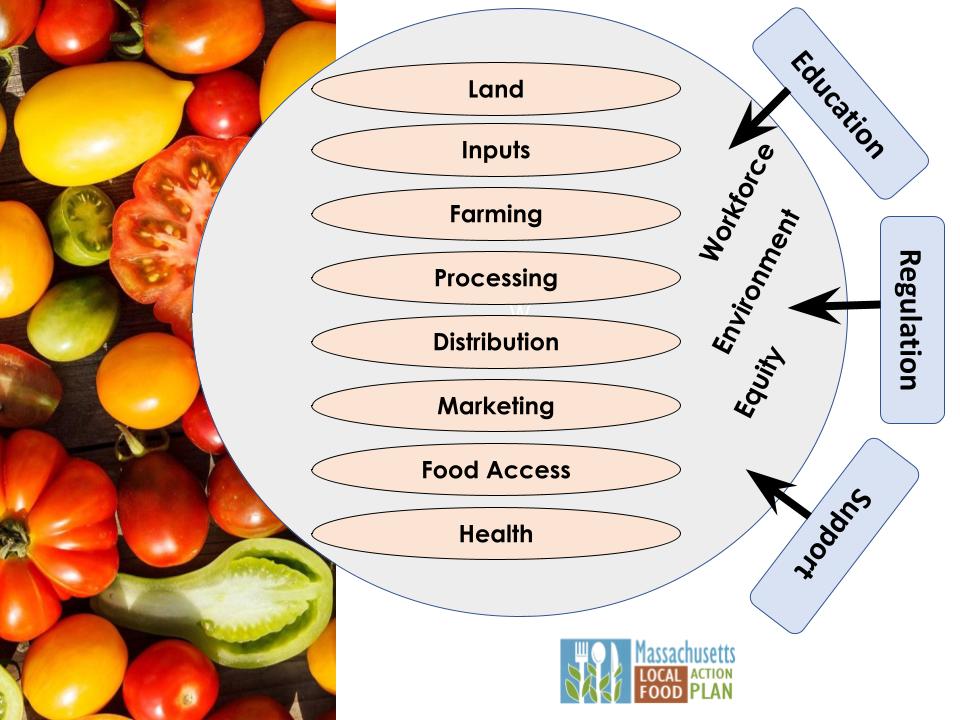
  • The Massachusetts Food Policy Council gathered input for the plan over two years. Working groups conducted regional and sectoral listening sessions and one-on-one interviews. Staff-members conducted targeted outreach to underrepresented communities like BIPOC and farmers who are often shut-out of these processes due to different barriers to access. An executive committee, made up of members of working groups, met on a regular basis during this time to move the project forward.
  • Each chapter of the plan, coinciding with a working group, followed important guiding lenses like workforce, environment, and equity. The Massachusetts plan also had a structured hierarchy for implementation where the goal is at the top, followed by a recommendation, and an action. The plan is available to read online.
  • Planners identified three stakeholders for implementation: legislature, administration, and private sector stakeholders. These stakeholders eventually formed the Massachusetts Food System Collaborative.
  • The Massachusetts plan concludes with quotes from everyone who provided feedback in order to include every voice.
  • Conclusions:
    • a good plan includes education and organizing
    • engagement is key but know when youโ€™re done
    • work with policy makers
    • identify needs for ongoing discussion
    • be clear on what completion means
    • have an implementation plan

Name: The Maine Food Strategy Framework

Year Completed: 2016
Government Affiliation: Initially, the plan lacked support from the state government.
Fun Fact: Prior to the framework, Maine Food Strategy developed a Fisheries Primer to explore food system issues for seafood.

  • Maine Food Strategy found that government buy-in and support was necessary, but it was also important to maintain leadership during the transition from NGO work to government-supported work. Government involvement was also helpful for funding, which is difficult to obtain and sustain for planning and network activities otherwise.
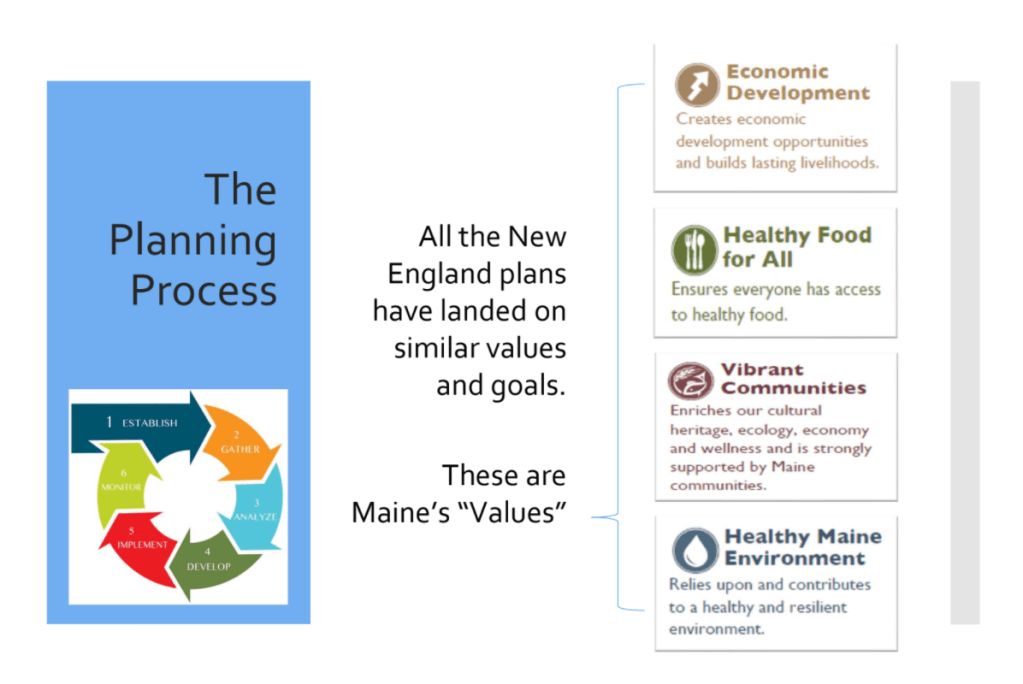
  • After assembling the steering committee, Maine planners looked at past plans and other similar plans. From there, the committee established values and goals. Each value area had a coinciding section of the plan. The plan is available to read online.
  • Steering committee members gathered input on the values and goals through a number of stakeholder outreach activities and surveys. Maine Food Strategy made an effort to join organizations at their meetings instead of asking organizations or individuals to attend a different meeting. Maine Food Strategy organized focus groups to reach migrant workers in the state.
  • Implementation included identifying organizations working on projects or providing services related to the goals and methods to track those changes.
  • Conclusions:
    • early governmental support is important
    • be transparent about who is influencing the process
    • be flexible with input – meet groups where they already meet
    • buy-in is important for implementation – stakeholders involved in the planning process will be encouraged to reference the plan

After Wintonโ€™s and Tanyaโ€™s presentations, participants broke into groups to have conversations about the plans they just heard and how they feel about a Connecticut food action plan. All groups had incredible conversations, but here are the most talked-about topics:

  • Getting input from necessary stakeholders from the very beginning.
  • Ensuring that BIPOC and marginalized voices are represented in the plan.
  • Creating valuable relationships that eventually build trust in the plan. Transparency is going to be very important, especially when gaining trust.
  • Getting government support at an early stage.
  • Hiring experts and compensating people for work and input related to the plan.
  • Identifiable gaps: CT is full of silos in both our town planning and initiative planning. We need to figure out a regional approach.

CFSA’s steering committee will consider these topics while drafting a food action plan for the state.

So, what can CFSA do?

  • CFSA must generate state support for the food action plan. The Connecticut Food Policy Council has added CFSAโ€™s updates as a consistent agenda item at meetings, which is an important step toward increased support and buy-in from the state.
  • CFSAโ€™s proposed timeline for the food action plan ramps up in 2022:
Timeframe Target 
2022 Food action plan input, framework, equity strategy, plan assessments 
2023 Food plan input, first draft, food action plan bill 
2024 Food plan input, final draft 
  • CFSAโ€™s next step will include strategizing ways to gather input for the food action plan with an emphasis on equity in our state. From there, CFSA will develop ways to encourage stakeholder buy-in and accountability.

CFSA relies on your input and activity to achieve these goals. If you would like to get more involved in CFSA, consider applying to join the steering committee. Email communications@ctfoodsystemalliance.com for more information.

Climate & Connecticut’s Food System

On Friday, October 22, 2021, Connecticut Food System Alliance (CFSA) hosted the first session of this yearโ€™s virtual summit, Growing Together. This session, Climate and Connecticutโ€™s Food System, focused on the ways that climate change has already impacted our state, and how CFSA can craft an equitable and sustainable food action plan with climate change in mind. CFSA welcomed Chelsea Gazillo, Director of the Working Lands Alliance and American Farmland Trust‘s New England Policy Manager, to moderate the discussion between Aziz Dehkan, Executive Director of the Connecticut Roundtable on Climate and Jobs, and Kip Kolesinskas, Co-Chair of the Working Lands Alliance.

Kipโ€™s presentation focused on climate changeโ€™s impacts on Connecticut and our stateโ€™s agriculture. Climate change has already made a measurable impact on Connecticutโ€™s environment. A warmer climate, droughts, and floods are creating new obstacles for fruit, vegetable, livestock, and dairy farmers in our state. Kip outlined a number of key climate concerns for food and farming in out state:

  • Increased heat stress will compromise crop yield and quality, and livestock and dairy production will suffer as well
  • Increased weed and disease pressure will bring invasive species, and more crop disease due to an increase in rainfall and more CO2 in the atmosphere
  • Too much water will flood and saturate soils, compromise soil health, and bring additional crop disease
  • Sustained high winds are causing more tornadoes and therefore more wind damage
  • Opportunities for more perennial fruit crops
  • Opportunities for double cropping during the longer growing season

While experts expect climate change to further impact our environment, especially without mitigation, farmers can take steps to maximize crop yields during the longer growing season and engage in farming practices that capture carbon. In Connecticut, there is potential for diverse farming operations that can increase jobs, foster economic growth and development, and mitigate the effects of climate change. This could look like implementing regenerative agricultural practices and risk assessment. Read more of Kipโ€™s recommendations from his presentation available here.

Aziz pivoted the conversation to discuss the role that land use can play in climate change mitigation. Previously, Aziz was the director of the New York City Community Garden Coalition where he witnessed first-hand the ways that green spaces and community gardens can reduce flood damage. Land use siting could play a role in controlling the effects of climate change, especially siting that preserves open spaces and values smart climate infrastructure. Green infrastructure and farmland preservation do not have to be mutually exclusive, or at odds with each other. It is possible to be more strategic and creative about where states, cities, and towns site things like solar fields, affordable housing, community gardens, buildings, Amazon warehouses etc.

Aziz recommends building a comprehensive plan that challenges the idea of โ€œnew normal.โ€

โ€œI donโ€™t want โ€˜new normal.โ€™ Why would anyone accept โ€˜new normalโ€™ when โ€˜normalโ€™ hasnโ€™t been working?โ€

Aziz Dehkan

Communities and grassroots organizers have the potential to redefine โ€œnormalโ€ through a narrative that prioritizes sustainability, creativity, and equity in the food system. There is potential for a better system that preserves farmland, values farmers, includes better green transit systems, and scales down big ideas to what we can reasonably expect in Connecticut.

Chelsea, Kip, and Aziz all participated in the Governorโ€™s Council on Climate Change where they worked with other members to create policy recommendations regarding working and natural lands, equity and environmental justice, and infrastructure and land use. These recommendations provide a foundation for CFSAโ€™s food action plan which will incorporate the policy recommendations from GC3 and various similar initiatives from across the state. In fact, building a sustainable and equitable food system is one of the recommendations from the Working and Natural Lands working group. You can read more of the GC3 recommendations here.

Changing our food system will play a role in mitigating climate change. A local and regional food system could reduce transportation emissions, costs, and food waste. Farmland in Connecticut can protect and restore habitats for species migration, act as drainage in urban and suburban areas to mitigate flood damage, and provide food and job opportunities in our state. Currently, Connecticut is in the top 12 of most threatened states, along with Massachusetts and Rhode Island in New England. Farms Under Threat is American Farmland Trustโ€™s initiative to document threats to our agricultural land along with policy solutions to preserve farmland. Preserving working lands and implementing climate-smart farming practices on those working lands are crucial elements to building a local food system in Connecticut.

So what can Connecticut, CFSA, and individuals do?

  • Connecticut needs to protect natural resources and farmland. Preserving natural resources and working lands creates a more resilient environment while providing jobs, local food, and overall innovation. Connecticut also needs to create supportive policies and incentives that aid in this protection. This can include policies supporting infrastructure, labor, consumer education, research, and risk assessment.
  • CFSA needs to coordinate contiguous efforts with other like-minded planning organizations in the state like GC3. There is already a comprehensive list of recommendations from the Working and Natural Lands working group from the GC3 that we can use for the food action plan along with other efforts that align with different elements of our food system.
  • We need to come together for an โ€œall hands on deckโ€ approach that emphasizes and uplifts BIPOC voices that are often underrepresented in these planning efforts while overburdened with the impacts of climate change in our state. An organized, grassroots effort to reimagine our food system will get us past โ€œnew normalโ€ so we can define what โ€œnormalโ€ should look like on these terms.

Sarah Axe hired as New England Feeding New England Project Manager

The New England State Food Systems Planners Partnership (The Partnership) announces the recent hire of Sarah Axe as the New England Feeding New England (NEFNE) project manager to help increase the amount of food consumed in New England that is produced in New England to 30% by 2030.

The Partnership is composed of six leading NGOs (Vermont Sustainable Jobs Fund, Maine Food Strategy, the New Hampshire Food Alliance, the Massachusetts Food System Collaborative, Connecticut Food System Alliance, and the Rhode Island Food Policy Council) responsible for supporting the development and implementation of their stateโ€™s food system plan, and is part of the Food Solutions New England (FSNE) regional network. The Partnership recently launched the New England Feeding New England Project, bringing together businesses, organizations, community leaders, and state agencies working to build a more sustainable food system across New England and to develop a plan to strengthen the viability and resilience of the regionโ€™s food economy.

The planning process will develop production milestones, identify policy opportunities, and recommend investments that can expand and fortify the regionโ€™s food supply and distribution systems to ensure the availability of adequate, affordable, socially, and culturally appropriate products under a variety of rapidly changing climate, environmental, and public health conditions. The goal is to increase the amount of food that is produced and consumed in the region so that by 2030, 30% of the food consumed in New England is produced within New England.

Axe is responsible for implementing and overseeing the New England Feeding New England project. She previously worked as a consultant to public and private entities working on food systems projects, such as the Good Food Purchasing Program and Double Up Food Bucks. Prior to consulting, she worked in the City of Austinโ€™s Public Health Department as the Food Access Coordinator, where she managed a portfolio of healthy food access initiatives. Axe holds a Masterโ€™s Degree in Public Affairs from the University of Texas LBJ School of Public Policy.

โ€œHaving just moved back to New England from living in Austin, TX for 10 years, I am excited to put my program management, strategic analysis, and relationship building skills to work in this region and focus on this important food security project,โ€ said Axe. โ€œAs we saw from the crop devastation in Texas due to recent climate change induced freezing weather last winter, and the food supply chain issues it caused, each region of the U.S. needs to be more self-reliant for a greater percentage of its own food supplies. Doing so will make us less vulnerable and more nimble to respond to climate change and pandemic caused food supply disruptions.โ€

Axe said the NEFNE project is currently looking for farm and food systems researchers who bring a strong equity lens to their research, who reflect the geographic, age, gender, racial, and ethnic diversity that make up our region, and who are interested in being part of a team that will explore how New England can meet 30% of its food needs within the region over the next 10 years.

To learn more about NEFNE and the projectโ€™s mission, visit nefoodsystemplanners.org.

About the New England Food System Planners Partnership:

The New England Food System Planners Partnership comprises six statewide organizations including Vermont Sustainable Jobs Fund, Maine Food Strategy, New Hampshire Food Alliance, Massachusetts Food System Collaborative, Connecticut Food System Alliance, and Rhode Island Food Policy Council, who each work to strengthen their stateโ€™s food system. The project was launched through a public-private partnership with funding from The John Merck Fund, the Henry P. Kendall Foundation, and the USDA Regional Food System Partnership grant program. Funding for this project was made possible by the U.S. Department of Agricultureโ€™s (USDA) Agricultural Marketing Service [grant agreement ID 6000016070]. Its contents are solely the responsibility of the authors and do not necessarily represent the official views of the USDA.